WBC 2026: Reading the Competitors’ Stories Alongside the Rankings
What competitors from producing countries brought to WBC 2026, how to read the rankings, and a question for every champion: what comes next?

Open the results of the 2026 World Barista Championship and the same names appear in different orders. The competitor who led the first round finished fifth in the final. The fourth-place semifinalist became champion, while the last competitor to qualify for the final finished third. For anyone who followed the competition, these numbers invite a natural question: what determined the order on the day?
As spectators, we develop preferences of our own. We may support someone whose story stays with us, or expect a high score for an unfamiliar approach. When the results differ from our expectations, we look for moments that might explain the gap: the way a drink is introduced, the instructions given to judges, the sequence connecting the courses. We can examine these choices by watching again. An account of the result also needs the judges’ assessment of the drinks they actually tasted.
Understanding the problem a competitor wanted to address gives us something to study after the results are known. We can follow the reasons for bringing environmental concerns into ingredient selection, the judgments changed by running a farm, or the intention to share knowledge received from colleagues. This time, I want to read those choices with the results beside me.
What can changing rankings tell us?
In the final, Pan Wei scored 575.5 and Malaysia’s Shing Win scored 567, a difference of 8.5 points. Frederick Ruben of the United Arab Emirates followed with 528.5, then Australia’s Gabrel Tan with 526.5. Jane Kawinnart scored 521 and Canada’s Jill Hoff 486.5. The six had reached the final by different paths.
| Competitor | Representing | First-round rank | Semifinal rank | Final rank / score |
|---|---|---|---|---|
| Pan Wei | China | 2 | 4 | 1 / 575.5 |
| Shing Win | Malaysia | 7 | 1 | 2 / 567.0 |
| Frederick Ruben | United Arab Emirates | 6 | 6 | 3 / 528.5 |
| Gabrel Tan | Australia | 4 | 5 | 4 / 526.5 |
| Jane Kawinnart | Thailand | 1 | 2 | 5 / 521.0 |
| Jill Hoff | Canada | 3 | 3 | 6 / 486.5 |
The table shows relative positions within each round. Shing Win moved from seventh in the first round to first in the semifinal. Pan Wei progressed from fourth in the semifinal to the championship. Frederick Ruben took the last qualifying position in the semifinal and finished third. Knowing the previous order still left the next round open.
Scores belong to their respective rounds and do not carry forward. Under the rules, the components of the first-round total also differ from those of the semifinal and final, making rankings the more appropriate starting point for reading across rounds. Totals tell us the overall assessment; individual scoresheets explain its components. The material available here provides totals and rankings. Explaining where taste or service made a difference requires itemized scores and judges’ feedback. Keeping that distinction lets us study the choices alongside the outcome.
Questions carried beyond the final
The performances from Brazil, Bolivia and Japan brought environmental concerns, the people involved in production, and relationships with producers into the drinks. Brazil’s Daniel Vaz finished 27th in the first round. Bolivia’s Nicolas Vargas placed 12th in that round and 11th in the semifinal. Japan’s Keisuke Honma advanced in 15th place and finished eighth in the semifinal. Returning to their explanations with these results in mind helps us consider both what we want to learn and the outcome of the competition.
Daniel Vaz connected climate concerns to his ingredients. He began by describing his experience of a farm fire, then introduced coffee flowers, cacao and honey through the environments in which they grow. For the milk beverage, he described equal parts lactose-free dairy milk and oat drink. His question was what flavor and texture he could prepare while maintaining an environmental concern.
What interests me is how that concern reached the choice of ingredients. A café introducing plant-based drinks faces related questions: which coffee they suit, whether they deliver the texture customers want, and whether supply and cost are manageable. Daniel’s combination offers one proposal to examine. Bringing an environmental concern into a menu means considering these conditions together.
Nicolas Vargas of Bolivia described the choices behind a cup through the process of making music. Producers appeared as composers establishing a coffee’s sensory foundations, the roaster as the person developing its character, and the barista as the person refining its final expression. He introduced coffees from Panama and Bolivia and explained how their producers’ choices had shaped them long before they reached him.
In this structure, the barista understands the work that came before and contributes decisions of his own. Nicolas connected his courses as a solo, a duet and an orchestra, explaining relationships among coffees and people. In the signature beverage, he introduced a Bolivian producer’s coffee as central to the composition. Presenting his country’s coffee and interpreting work from other origins became parts of the same performance.
His account makes me consider whose choices we explain when introducing coffee. We can describe the character a producer sought, what a roaster wanted to preserve, and how the barista carried that work forward. This gives the audience a sequence for understanding the judgments of several people within a cup. His attention to those collaborators, while presenting coffee from his own country, makes the performance worth revisiting.
Keisuke Honma placed his introduction to coffee and his relationships with producers within the order of his drinks. In the semifinal milk course, he described the Ethiopian coffee experience that had started his journey. With the espresso, he spoke about Panama Geisha and his exchanges with a producer. The signature beverage brought the two coffees and other ingredients together, continuing those connections. His account of where he began helped explain what he wanted to serve the audience.
This specificity also helps when talking about producer relationships. Alongside the number of years we have traded, we can explain which coffees that exchange led us to choose and what we want people to taste. The changes at origin that Honma described belong to his account and experience. Through it, the audience can follow choices behind a coffee’s name.
Each of these three competitors found a way to communicate something that mattered to him. Daniel included the environment among his criteria for ingredients. Nicolas connected the roles of the people contributing to a cup. Honma explained producer relationships as reasons for choosing coffee. Following those decisions reveals some of the thinking that preceded the drinks.
How running a farm changed the questions
Starting a farm became an occasion for Suhas Dwarakanath to reconsider his entire outlook, beginning with how he chose coffee. Representing India, he opened with that experience. He said he had bought the farm after running several businesses, including a roastery and café, and had expected to do well. Watching planted trees die brought him into contact with problems that confidence in his coffee knowledge alone could not resolve.
An important change in his account began when he asked another farmer for advice. Through a producer in Panama, he learned an approach that investigated the land and considered how to grow other crops while waiting for coffee to generate income. The criteria for making decisions on the farm expanded. The wish to plant coffees people enjoy now included whether they could grow on that land and whether he could continue operating the farm over time.
That experience also affects how we see producers. When a barista describes a desired flavor, a farmer must also consider the time and cost before harvest, existing equipment, and the land. Suhas spoke as someone who had encountered that gap himself. He described the help he had received from other producers and closed by asking for emotional, practical and financial support for small farmers.
The support he requested can take concrete form through continuing trade and exchange: listening to difficulties, establishing terms both sides can manage, and considering whether a relationship can continue through the next purchase. His performance left a question about the relationships a person needs to keep farming. A stage for introducing flavor also made room to discuss the conditions of continuing to run a farm.
Introducing coffee from your own country
Peru’s Chiara Nicolini began with her reason for choosing Peruvian coffee. She asked the audience to consider why a competitor from a producing country using her own country’s coffee should become a noteworthy story. In her presentation, that coffee was both a material prepared for the demands of the stage and something she wanted more people to know and evaluate.
Chiara described testing different choices with producers and her intention to leave capabilities locally. The focus extended from one competition coffee to the work that would follow. What knowledge remains with producers after collaborating with an outside expert? Can they continue comparing and choosing for themselves? She also closed by expressing a wish to build conditions in which Peru and other producing countries could consistently present excellent coffee.
The outcome Chiara hoped for extended to later harvests and collaborations. She wanted her participation to create an opportunity for local producers’ coffees, and the experience gained in preparation to serve subsequent work. This adds a question for the audience as well: alongside the impression a coffee made, whose work have we come to know?
Ecuador’s Juan Zambrano brought the ability of farming families to continue under climate change into his presentation. Resilience and adaptation were his themes. While introducing the milk beverage, he spoke about choices that could allow families to maintain a livelihood on their land. His account connected coffee’s future to the lives of people working at origin, alongside the outlook for production.
The possibility of continuing to farm was what Juan wanted to protect. His presentation linked the next harvest and the future of drinks made from it to farming households. Where Chiara spoke about conditions for continuing to introduce her country’s coffee, Juan spoke about conditions for the families growing it to keep working. Their concerns began in different countries and experiences, while looking toward the time after the competition.
What a Panamanian barista brought to the stage in Panama
Benjamin Roque, of Altieri Specialty Coffee in Panama, spoke about coffee changing his life and perspective. In the semifinal, he explained that a job begun to pay for his studies had become a reason to keep learning about coffee. He also described difficulties in earlier competitions and the importance of sharing what others had taught him. Panama appeared as both the origin of his chosen coffee and the place where he had continued his work.
Benjamin explained his country’s coffee as someone who had learned and worked there. He introduced coffees from the same farm differently across the courses, connecting them to his experiences. His professional background informed what he chose and what he wanted to communicate. An account of origin included the experience of a service professional working there alongside the farm’s story.
At the end, he expressed a wish to share knowledge and perspectives in cafés, farms and roasteries as well as on the competition stage. This connects with Suhas’s experience of receiving help from farmers and Chiara’s intention to leave knowledge locally. When something learned from another person becomes useful to someone else’s decisions, it remains available after a meeting or competition preparation has ended.
These four accounts show different ways of relating to coffee in producing countries: changing decisions through running a farm, widening opportunities for local coffee, speaking about farming families’ livelihoods, and sharing what coffee has taught someone. Listening to those experiences separately helps us understand who needs what support, and what each person proposes in farming, trade and knowledge exchange.
What will you do after becoming champion?
A winning performance gives us an opportunity to examine choices that received a high assessment. We can learn by following why Pan Wei chose his coffee, how he participated in the work of producers and his team, and the sequence through which he communicated that preparation to the people drinking it. Asking the same questions of other competitors lets us compare what mattered to each and how they pursued it. On a second viewing, with the results known, we can stay with those choices longer.
I am also interested in the work that follows. Who will receive the knowledge gained during preparation? What relationships with producers will continue? How might new attention become an opportunity for colleagues and communities? The capabilities Chiara hoped to leave locally and the knowledge sharing Benjamin described already placed that next step within their performances.
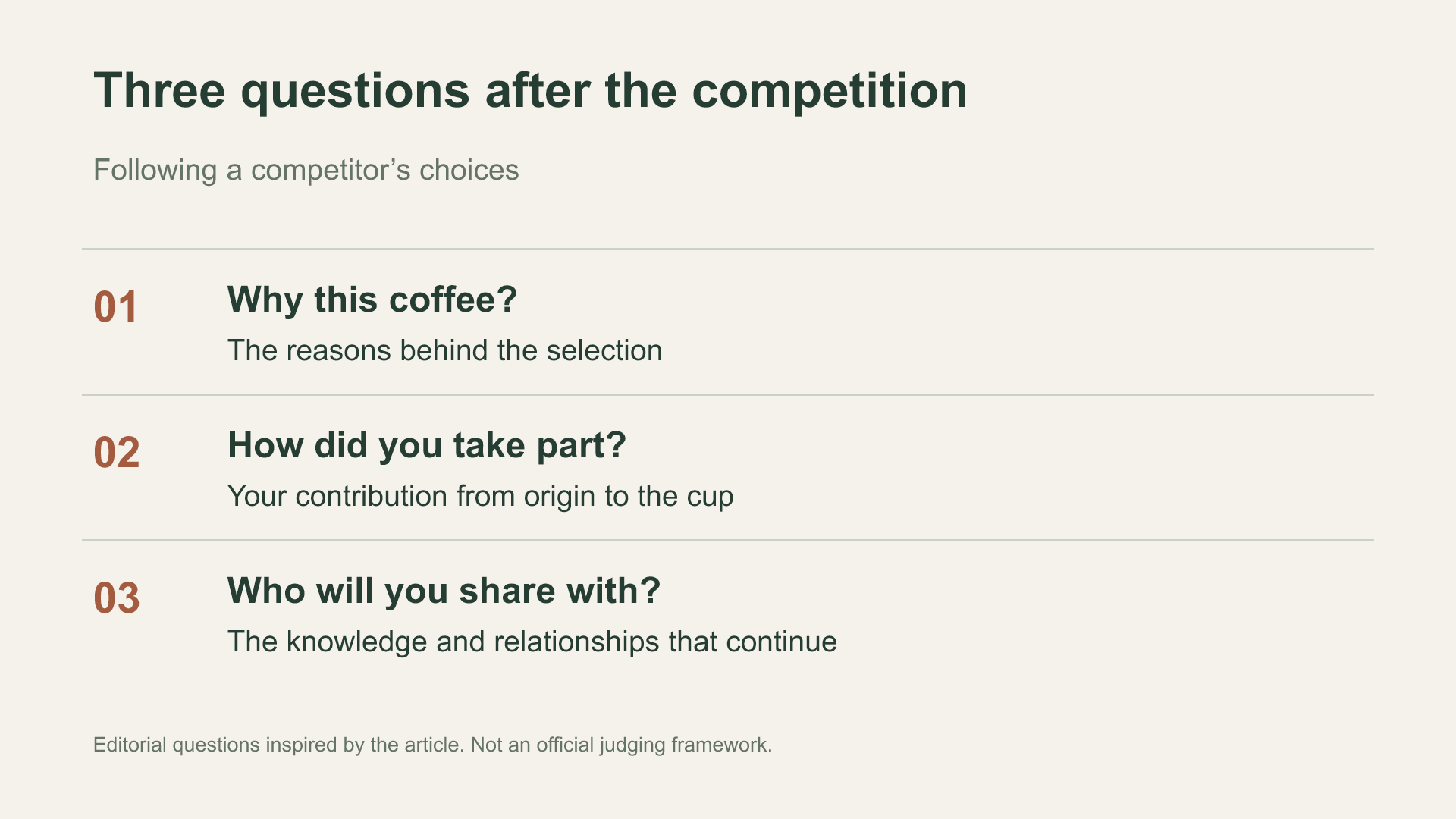
I would like to ask readers and barista champions the same questions. Why did you choose this coffee? How did you participate in its journey into a cup? Who would you like to share what you learned with now? Watching a competitor’s video, we can answer while considering our own work and choices.
And I would like to ask a champion one more thing. The competition has brought more people to watch your choices. With that attention, what would you like to continue?
You have become a champion. What comes next?