When the Peach on the Bag Is Hard to Find
What if you cannot find the peach on the bag? Looking at how tasting notes are selected, interpreted and used, I ask what a coffee description owes its reader.


Imagine choosing a bag of coffee labelled “peach, jasmine, honey” because the peach sounds appealing. You brew it, take a sip, wait a little and try again. There is some brightness and a familiar bitterness, but the peach is harder to find. You do not dislike the coffee. Yet as you reread the bag, your question changes a little. You began by wondering what the coffee would be like. Now you wonder whether you are tasting it properly.
The brightness they noticed a moment ago may still be there. What has changed may be their confidence in describing it. Can they use words that are not on the bag? Is having enjoyed something enough? If a word chosen to enrich the experience makes someone hesitant to describe their own cup, that is a moment I want to attend to as someone who explains coffee.
I want to stay with this scene for a moment. The roaster may have chosen the word to share something they enjoyed. The drinker may have trusted that description and looked forward to discovering it. Both wanted a better understanding of the coffee, yet a short description has introduced an unexpected burden. Tasting notes can offer one person a welcome guide while leaving another feeling that their senses need approval.
What else, then, might help this person? A fuller explanation of peach could be useful. Yet even afterwards, the question of whether they enjoy this coffee remains. I would like following a note to make new discoveries possible while leaving people able to trust and describe what they felt. That is the work I want to ask of a coffee description.
The words that reach the bag
The words on the bag can look so definite that the drinker feels they alone have missed something. Understanding how those words reached the label gives them another way to read it.
Counter Culture Coffee offers one example of how this happens. The US roaster explains that its team tastes coffees before release and typically uses the descriptors that appear most frequently in their notes on the packaging. In this case, the label condenses a team's observations.
Choosing three words can itself be an act of consideration. A bag cannot carry everything discussed at the tasting table, and a prospective buyer needs an initial point of reference. But what the writer leaves out because it seems familiar may be unfamiliar to the reader.
A passing association with peach and peach as the central aroma are different observations, yet either might become “peach” on a bag. The same name can leave out how prominent an impression was and how it related to the others. Understanding a short note therefore means considering both its words and the explanation it leaves out.
What it takes to share a word
For “peach” to be useful, the writer and reader need to imagine experiences that overlap to some degree. We cannot expect everyone to remember precisely the same peach. Firm flesh, a ripe aroma and the sweet impression of canned fruit offer different starting points. In this example, the fruit's name is quite specific and still leaves room for clarification.
Professional sensory work gives us a way to understand why shared references matter. World Coffee Research's Sensory Lexicon connects descriptors with definitions and reference samples. It provides something people can consult together when asking what a term means. To me, the important idea is the effort to share a basis for comparison.
Shared references help people establish what a word points to. A drinker needs that connection too: hearing which aspect of peach the writer meant gives them something to compare with their own impression. Yet understanding the same aroma does not settle whether they will enjoy the coffee. Another question remains before they choose.
Understanding an aroma does not settle whether I will enjoy it
Suppose an explanation helps the drinker understand what the writer meant by peach. They might still hesitate to buy the same bag again. The pleasure of recognising an aroma and the wish to drink it every day do not necessarily arrive together. “Jasmine” does not promise a more enjoyable cup for them than “chocolate.”
The Specialty Coffee Association's Coffee Value Assessment, or CVA, separates descriptive assessment of sensory attributes from affective assessment of perceived quality. That distinction offers a useful starting point for an ordinary reader: we can read a statement about what someone perceives separately from a statement about how they judge it.
I would take this a step further. Recognising a characteristic, considering a coffee well made and wanting to drink it tomorrow morning are separable judgments. The last involves personal preferences and circumstances. An unusual aroma might be interesting, while a familiar coffee is what someone wants at breakfast. A highly regarded coffee may leave them unmoved. There may be more to understand about that response, but choosing differently does not establish a deficiency in their senses. I would like tasting notes to leave room for explaining those choices too.
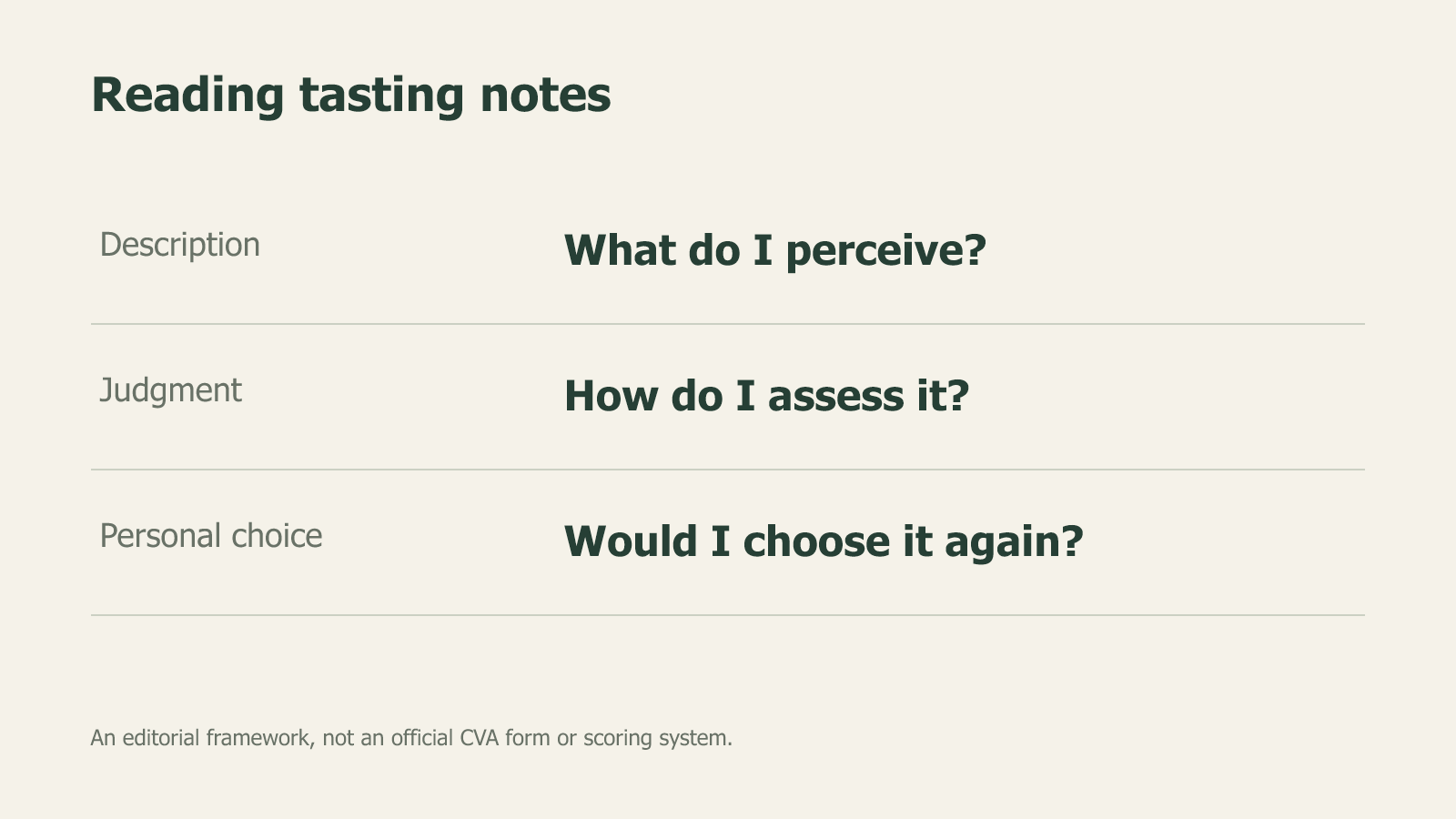
Where does the description meet my preferences?
Imagine this person choosing their next coffee and saying, “This time I would like something a little less acidic.” At first they could only say they had not found the peach. Now they are describing something they would like to change about their cup. That gives the seller a place to begin.
Before reaching for another bag, the seller could ask what felt unfamiliar last time. Was the sourness strong, or did they miss the nutty character they usually enjoy? Those answers could lead to different suggestions. “Less acidic” does not describe an entire preference, but returning to a cup they have already drunk creates a basis for comparing the next one.
After hearing that account, the seller has a clearer idea of what to explain. They can describe where the suggested coffee resembles a cup the customer enjoyed and where it differs. “Peach” can find a place in that conversation as a clue to compare with the experience the customer wants, without becoming an aroma they must correctly identify.
A bag cannot contain all of this conversation. But when there is an opportunity to expand a short note, it is worth pausing before adding another aroma name. What might someone choosing this coffee for the first time want to know? A sentence that answers that question could make a coffee feel more approachable than three words alone.
A sentence that answers the customer’s question
A customer concerned about acidity needs an explanation of how the coffee’s acidity actually came across. “Peach, jasmine, honey” cannot supply that answer alone. A fruit name does not establish strong sourness, and “honey” does not establish gentle acidity. We need an observation of the particular characteristic the customer wants to understand.
I would first ask the writer how prominent the acidity was and how it felt alongside the other tastes. A comparison can help too. If that comparison has actually been made, a sentence such as “The acidity came across more clearly than in the blend you usually drink” gives the customer a basis for considering their expectations without adding another aroma name. Someone curious about floral aromas might instead benefit from hearing which aroma led. What we add depends on the reader’s question.
It also matters how closely the description relates to the cup they plan to drink. For someone who adds milk at home, an impression checked with milk can help them choose. An aroma observed only in filter coffee cannot simply be promised across every drink. Listening to how someone will drink the coffee, and answering from what has been checked, brings the note closer to their actual choice.
For the person who cannot find the peach
Return to the person at the beginning. They still cannot find the peach. Perhaps they can say instead that they enjoyed the brightness, but found the coffee a little unfamiliar for everyday drinking. The next conversation can begin there. What felt unfamiliar? What was comfortable about their usual coffee? The seller also gets a chance to hear how their chosen words were understood.
When I explain coffee, I hope the drinker will discover more in it. I can also see how that hope might give too much space to finding the words I chose. Whether an explanation has reached someone cannot be judged only by whether they recognise the same peach. I would also like to hear whether they can add words of their own and talk more comfortably about what they want to drink next. The peach may never appear. What they enjoyed in the cup can still remain.
Notes & Sources
Checked 5 October 2026. Counter Culture provides a primary account of its own label-selection process. WCR informs the discussion of shared sensory references; SCA supports the distinction between description and perceived quality. The bag, customer scenarios and sample comparison sentence are hypothetical, not measured results or interview findings. Featured artwork is AI-generated; the diagram is an original editorial framework.