Whose Cup Does an Expensive Geisha Become?
Why is Geisha so expensive, who buys it, and how is it sold? BOP and estate auction records, alongside retail examples, reveal the distance between a lot’s price and a cup’s value.

On Julith’s booking page, a coffee experience is listed at AED 3,600 per person. The Dubai company offers a guided tasting of Nido 7 from Hacienda La Esmeralda, the washed Geisha winner of Best of Panama 2025. Both the price and the way of ordering are some distance from buying a coffee on the way to work.
The questions arrive together. Why is Geisha this expensive? Does it taste good enough to justify the price? Who buys it, and how do they sell it? Following a lot from auction to a customer’s cup connects these questions. A lot is a separately identified quantity of coffee traded as a unit. Its purchase price and the value of the final cup describe different decisions along that journey.
I want to set the initial surprise aside long enough to examine those decisions. First, what exactly changed hands? Then, what did the buyer intend to offer, and what might the person drinking it want? The 2026 BOP and estate auctions help describe the purchase; a documented retail offer from the 2025 auction helps follow what happens afterwards. Keeping those years and lots distinct is essential.
From a variety name to a particular lot
Geisha is a coffee variety. World Coffee Research describes Panamanian Geisha as having exceptional quality potential at high altitude. The useful word here is potential. A variety name can begin an expectation; it cannot finish the assessment of a particular bag of coffee.
Imagine finding “Panama Geisha” on a menu. That identifies a country and a variety. Adding a farm name narrows the origin. Harvest year, processing method and lot identity make the description more specific. A coffee from a winning farm may still be a different product from the winning lot. The farm’s reputation does not transfer an award score or a record auction price to every coffee it produces.
Best of Panama, or BOP, makes this distinction especially important. The auction trades selected, evaluated lots from a particular year. Esmeralda’s 2025 washed winner scored 98 points; its 20 kilograms sold for US$30,204 per kilogram, a total of US$604,080. The precise statement is that this lot achieved that price in that auction. Calling it simply “the price of Geisha” removes information needed to understand the transaction.
That matters in both directions. Using one record lot to price an entire variety treats everyday retail Geisha and an auction winner as interchangeable products. Dismissing the whole difference because a much cheaper coffee shares the variety name makes the same mistake. Before assessing the price, we need to identify the coffee.
Looking beyond the record price
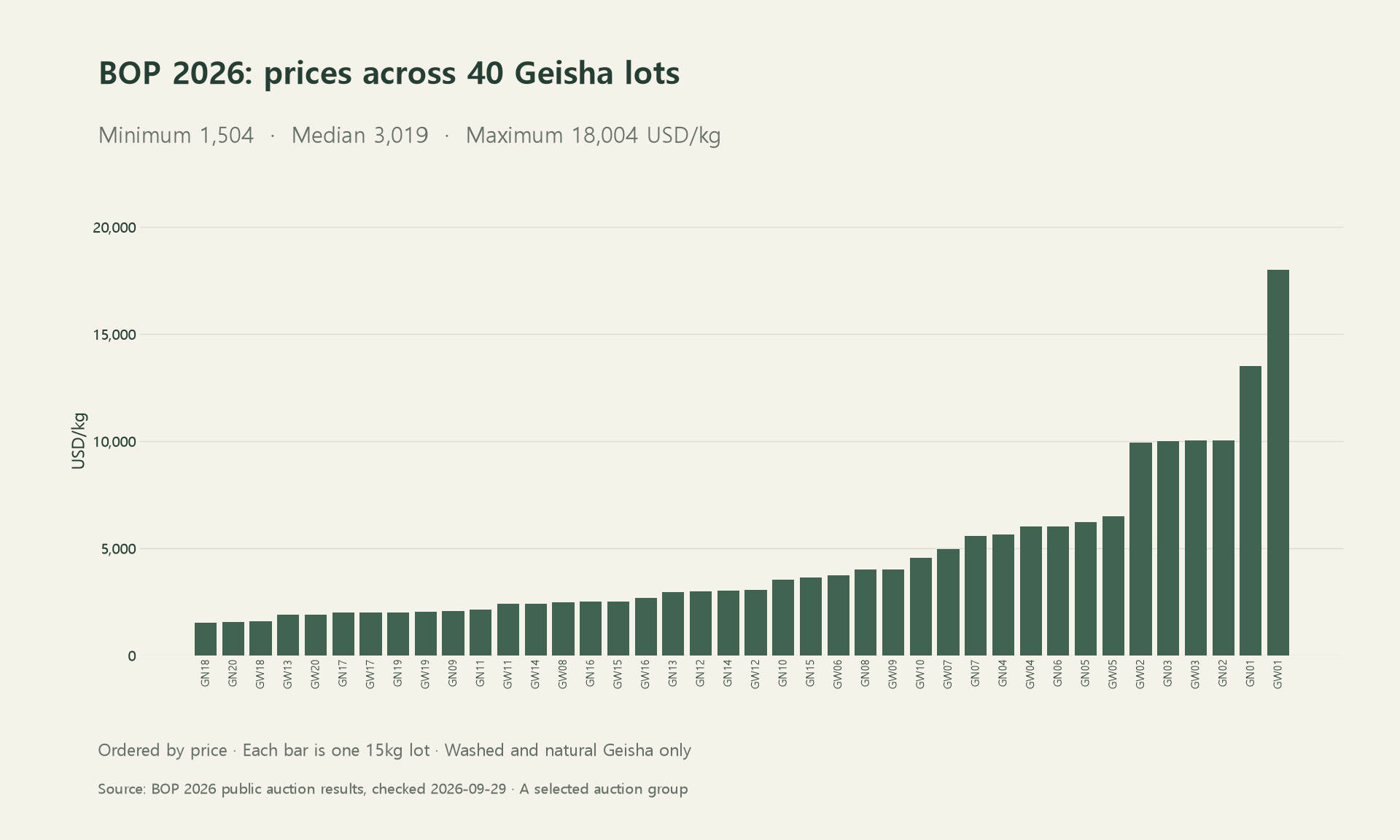
Across the 40 washed and natural Geisha lots at BOP 2026, prices ranged from US$1,504 to US$18,004 per kilogram. The median was US$3,019: the average of the twentieth and twenty-first prices when all 40 are placed in order. That offers a different view from the record alone.
It is still a selected competition group, not a representative sample of the Geisha market. Its spread shows why the variety name leaves so much unexplained. Identifying the producer, lot and circumstances of the transaction makes the question more useful.
Quantity changes the picture further. At the 2026 Lamastus Family Estates auction, Luito Geisha washed sold for US$14,710 per kilogram. Its two kilograms cost US$29,420 in total. The washed lot labelled “06:00” sold for US$6,316 per kilogram, but its ten kilograms required US$63,160. The lower unit price came with the larger purchase commitment. This comparison explains the importance of weight; it does not rank the coffees’ quality.
The two figures answer different practical questions. A unit price tells us how much is paid for the raw material; a lot total tells us the auction payment needed to secure that quantity. Transport and subsequent preparation costs still lie ahead. A buyer planning a very small tasting and one intending to serve more customers may need different quantities. Knowing both weight and price makes it possible to ask a more concrete question about the plan that follows.
When an assessment becomes a price
Identifying the lot still leaves a large number to explain. A high score and a high bid are connected, but there is no fixed conversion rate between points and dollars. One records an assessment within a judging context. The other records competition to purchase a limited quantity.
Suppose a roaster finds a remarkable coffee on a tasting table. “How much can I pay?” introduces questions beyond its flavour. Can the roaster introduce it convincingly to customers? How will the quantity be divided? Is the business ready to prepare it? What other spending would the purchase displace? This is an illustrative buying situation, not a reconstruction of any company’s accounts.
A competing bidder may have a different use in mind. Selling small packs of beans and serving a guided tasting are different proposals. Even if two buyers assess the coffee similarly, their plans need not give them the same spending limit. Understanding an auction price therefore involves asking who intends to turn the coffee into what kind of product.
That does not mean every expensive purchase can be explained as a demonstrably successful strategy. Auction results do not disclose a buyer’s budget, expected return or the value assigned to publicity. Those factors cannot be neatly separated from the final bid. Acknowledging the distance between the documented transaction and our interpretation is more useful than ending the explanation with scarcity alone.
Three meanings of “worth it”
Even after the price becomes more understandable, the personal question remains: will it taste good enough?
Several judgments sit inside that question. Describing a coffee’s sensory character, recognizing its competition result and deciding that we enjoy drinking it are related activities. They are not interchangeable. Someone may appreciate a clearly floral coffee while choosing a familiar, weightier cup for everyday drinking. That preference need not dispute the judges’ assessment.
In SCAP’s account of the lot handover, producer Daniel Peterson described jasmine, peach, a syrup-like impression and a persistent aftertaste. That offers a producer’s account of what to look for. It does not establish that everyone will perceive the same characteristics, or enjoy them in proportion to the price.
The comparison becomes especially difficult when prices diverge sharply. If a coffee costs ten times as much, should its aroma be ten times stronger, or the pleasure ten times greater? Enjoyment does not provide such a straightforward multiplier. A person interested in examining subtle differences and a person seeking an affordable, generous daily cup begin with different purposes.
If an opportunity to taste arises, identifying the advertised flavours need not become an examination. Consider the first sip and the impression after cooling, the feel in the mouth, and what remains after swallowing. Describing the experience in your own words can make it useful for a future choice. This is a suggested approach to maintaining personal judgment, not my tasting report on this lot.
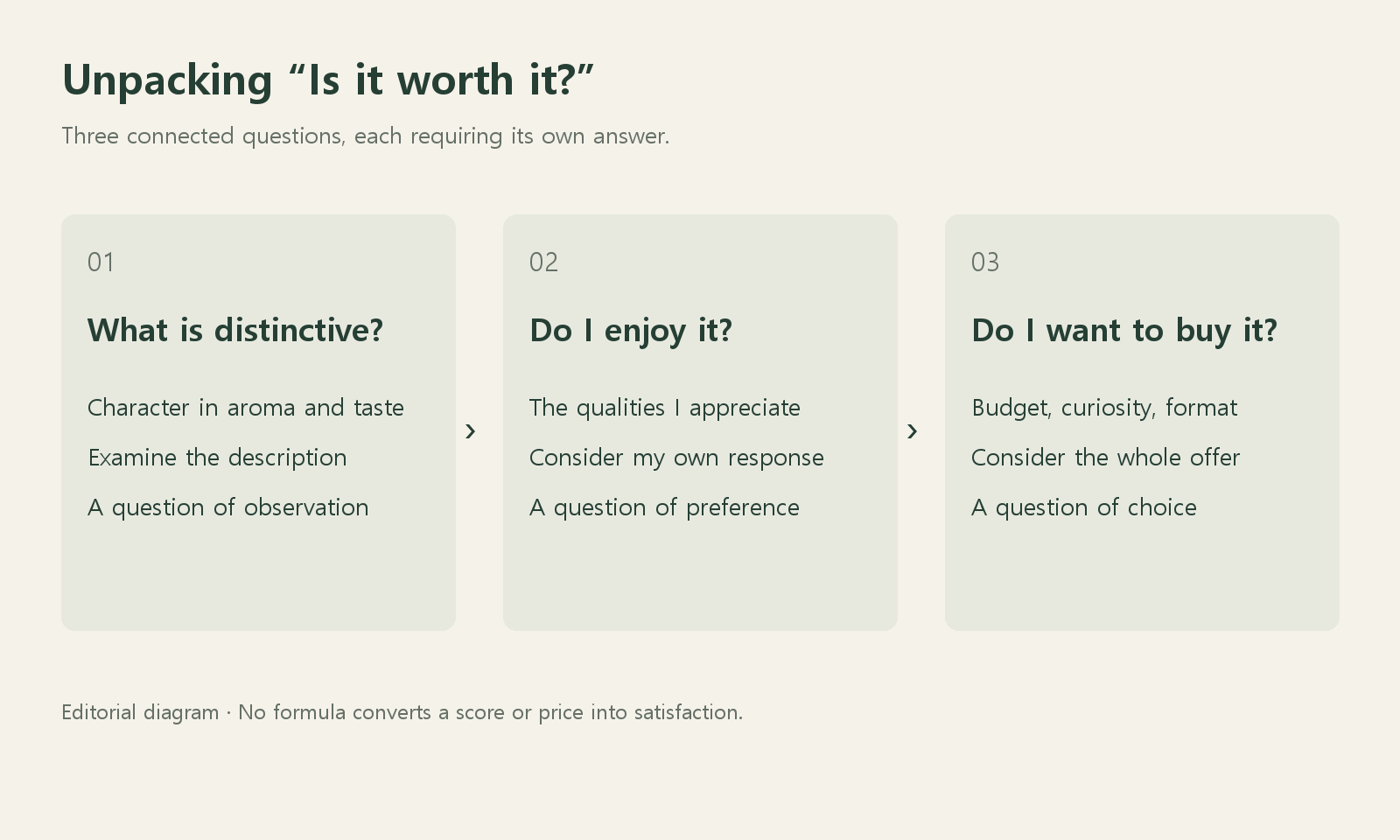
“Worth it” therefore calls for three answers: what is distinctive, how much do I enjoy that distinction, and do I want to pay this amount to experience it? Skipping directly to the last question makes it easier either to celebrate expensive coffee automatically or to reject it before understanding the proposal.
The buyer has another customer in mind
The winner fields also show more than one purchasing arrangement. BOP 2026 lists George Howell Coffee Company for GW02. GN01 lists several names, including RULI Coffee, Gluck Inc., Linking Coffee, Ryubeans and Coffee Me Up.
Estate auctions show similar entries. Esmeralda’s 2026 EA4 lists Lunoir Coffee, Archers Coffee, Hydrangea Coffee and M2M Coffee Roasters among others. The names do not disclose how payment, coffee or eventual sales were divided. A shared listing is evidence of the published participants, not a substitute for their private agreement.
The next question is what those buyers intend to offer. That is where the documented Julith example becomes useful.
Julith provides a concrete example. In remarks reported by SCAP, buyer Serkan Sağsöz identified quality and the judges’ assessment as central to the decision, and described the intention to create a special customer experience. These are the buyer’s stated reasons, rather than an independently verified business case.
The subsequent guided tasting gives that intention a visible form. The product is not expressed only as a weight of roasted beans. Someone prepares the coffee, explains its background and sensory character, and provides a setting in which the guest can attend to it. That arrangement will not have equal value for everyone, but it makes the proposed experience clearer.
There are two buyers in this sequence: the company acquiring green coffee at auction, and the customer selecting what the company offers. The first purchase makes the headline. The business question continues to the second: what does that customer expect, receive and take away? Winning the lot does not settle those questions.
A high auction price is consequently not evidence of successful retail sales. A booking page documents an offer and its listed price. Establishing how many customers paid, or whether the investment was recovered, would require other records. We can observe the format without claiming that its economics have been proven.
Ways to share a limited quantity
Guided service is one option. Hydrangea’s product page for Finca Nuguo BOP GW03 washed coffee lists small-pack choices including a 20-gram tube. It was marked sold out when checked. Because the page text does not establish the auction year, it is used here only as evidence of packaging format, not as a dated comparison with Julith’s winning lot.
A small pack changes the customer’s role. Instead of receiving a prepared cup, the buyer takes coffee home to brew with their own water and equipment. There is less need to purchase a large quantity, while preparation and storage decisions pass to the customer. A small amount creates access to an experience but also leaves limited room to repeat an attempt. Pack size is partly a decision about who takes responsibility for producing the experience.
Japan’s Saza Coffee presents another perspective. In the company’s official introduction, representative Taroh Suzuki describes aroma-focused buying and preparation, and a policy of sharing auction coffees and their evaluation through Geisha events. The relevant question is how a business helps people understand differences in coffee.
Comparative tasting can be one useful approach. Instead of encountering a single cup accompanied by the word “exceptional,” a guest can consider which differences between coffees matter personally. Several cups alone do not guarantee a better understanding; the comparison and explanation need to be appropriate. This is an editorial consideration for designing an experience, not a claim that a particular event’s educational effect has been measured.
Guided service, a small pack and a comparative tasting each make a different promise. The first puts preparation and guidance with the seller. The second gives the customer control over brewing. The third can provide context for noticing differences. The important test is how closely the format matches what the customer expected to receive.
A menu price is not a profit statement
Once a selling format becomes visible, a calculation is tempting: divide the purchased coffee into cups and multiply by the price. That can begin a scenario, but green weight divided directly by a roasted-coffee dose does not establish the number of saleable servings. Roasting changes weight, and coffee used in quality checks and preparation must also be considered.
Packaging, transport and service add further costs. There is also no guarantee that every planned serving sells. A listed price multiplied by a theoretical number of cups is a revenue scenario under assumptions. Profit requires actual costs and sales. Filling missing figures with convenient estimates can make the arithmetic look more certain than the evidence.
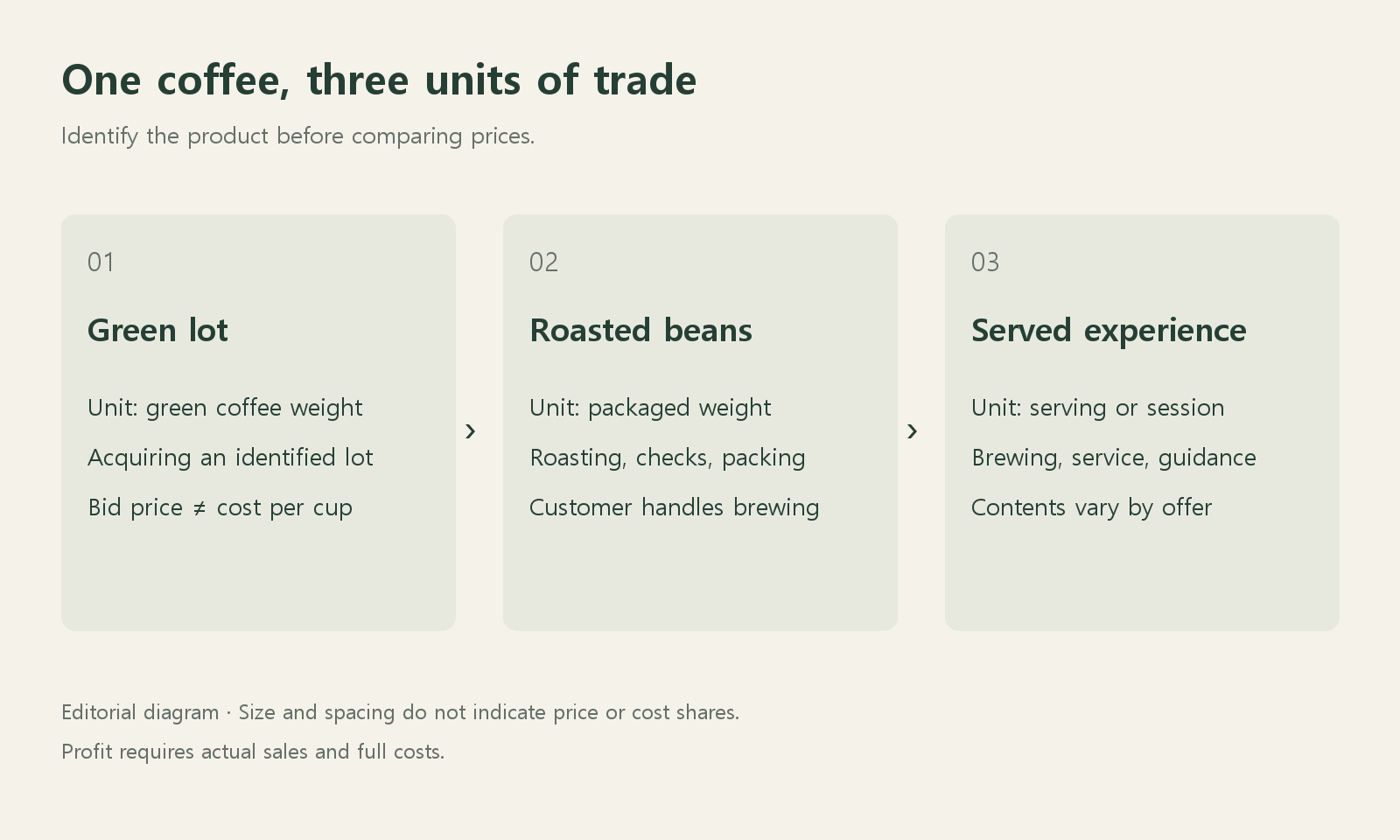
For that reason, this article does not convert international retail offers into a ranking of margins. A green-coffee auction price, a roasted-bean price and a guided-tasting price describe different units of trade. Explaining a price tag and establishing the financial performance of a business require different information.
Back at the booking page
There is no reason everyone should reserve that tasting. But the choice can now be described more precisely: an opportunity to experience an identified lot from a particular year, in a format prepared by a particular seller. Whether that opportunity suits someone’s curiosity and budget remains their decision.
The seller has a responsibility to make the decision understandable: identify the coffee accurately, explain what and how much is provided, and show what the price means in the actual experience. A producer’s name and an award record are valuable information. They cannot decide satisfaction on the customer’s behalf. A good explanation makes expectations specific.
For me, understanding expensive Geisha means following the question this far: from how a price was reached to who drinks the coffee, for what reason, and with what result. The auction number records the moment a transaction closes. The value of the cup is judged again afterwards, by the person who chose to drink it.
Notes & Sources
Sources checked September 29, 2026. This article draws on public documents, not personal tasting, a visit or an original interview. Product listings establish offers, not sales volumes or profit.
- World Coffee Research — Geisha (Panama)
- SCAP — 2025 BOP auction results
- SCAP — Julith lot handover: September 7, 2025
- Julith — Nido 7 guided tasting
- Hydrangea — Finca Nuguo BOP GW03, L1.5 Roast
- Saza Coffee — official introduction, “The value of coffee”
- BOP 2026 — Timeless Resonance
- Lamastus Family Estates 2026 — First Light:
- Hacienda La Esmeralda 2026 — 90 Years of Price Peterson
- MCultivo — Auction Events
Visuals: the price distribution chart uses recalculated public auction results. The featured image is AI-generated. Both explanatory diagrams are original editorial constructions; neither represents measured statistics or cost proportions. General buying and cost explanations do not purport to reproduce company accounts.