2026 Best of Panama: Reading the Market Beyond the Record
A ten-year look at auction prices, buyers, sensory direction, and what the 2026 results may be telling us about the Panama coffee market.

MARKET REPORT 001
September 2026
YOUNGJUN CHO
Coffee Research & Observations
Chief Coffee Intelligence (Head of Coffee), EightyPlus Coffee
Founder, Prism Coffee Works
한국어 요약
올해 Best of Panama 옥션을 보면서 가장 흥미로웠던 건 최고가가 아니었습니다.
2025년에는 US$30,204/kg이라는 기록이 나왔고, 올해 최고가는 US$18,004/kg였습니다. 이 숫자만 보면 지난해보다 시장이 조금 가라앉았다고 생각할 수도 있습니다.
그런데 전체 결과를 보면 이야기가 조금 다릅니다.
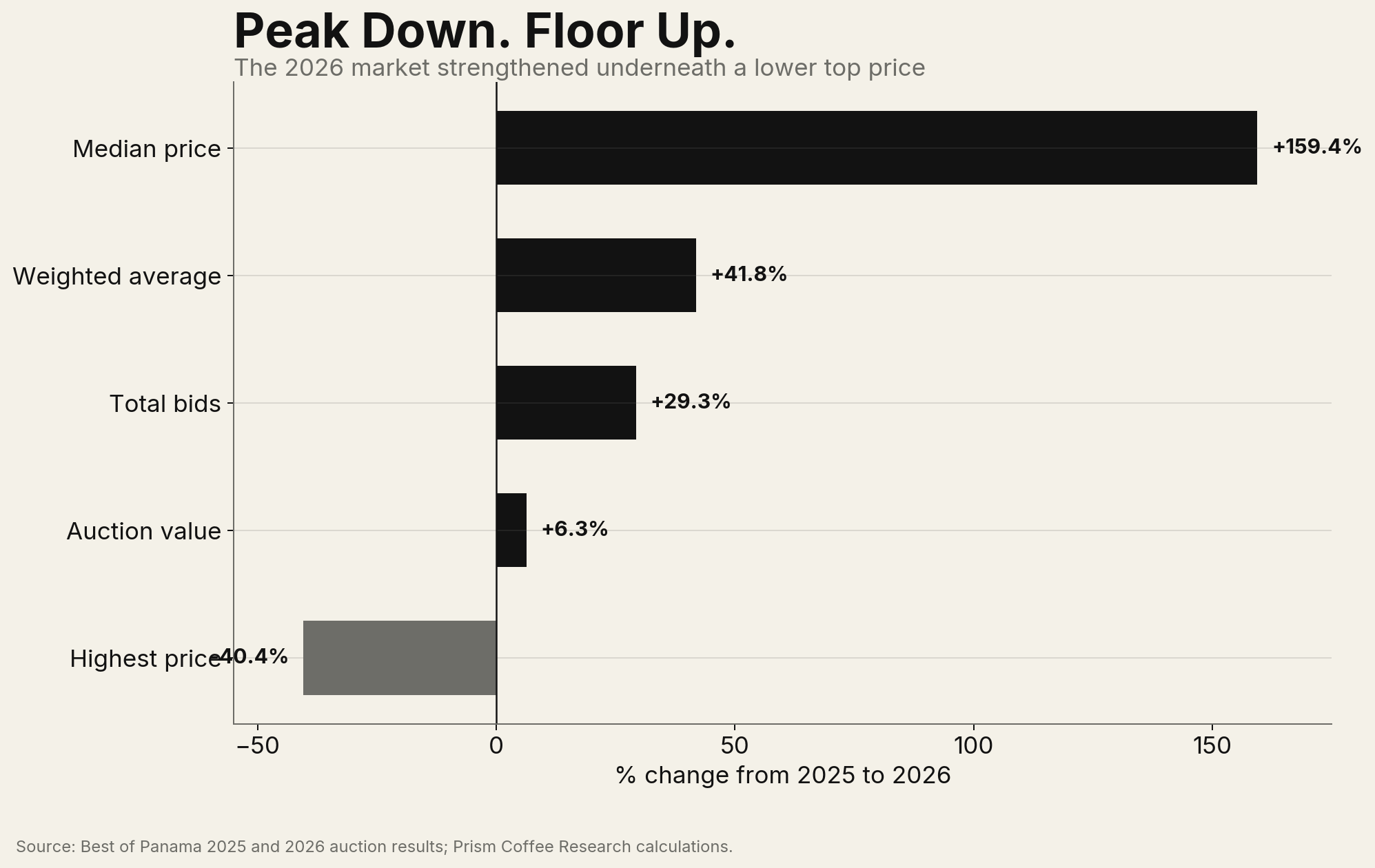
2026년에는 2025년보다 25% 적은 750kg의 커피가 출품됐지만 총 낙찰액은 US$2.861M에서 US$3.042M으로 늘었습니다. 평균가는 US$2,861/kg에서 US$4,056/kg으로 올랐고, 중앙값은 US$1,093/kg에서 US$2,835/kg으로 상승했습니다. US$1,000/kg을 넘긴 lot 역시 30개에서 48개로 늘었습니다.[1][2][3]
최고점은 낮아졌지만 시장의 아래쪽은 훨씬 높아졌습니다.
2025년이 기록에 시선이 집중된 해였다면, 2026년은 시장의 깊이를 보기 좋은 해였다고 생각합니다.
그리고 2017년부터의 기록을 함께 보면 이 변화는 올해 갑자기 생긴 현상은 아닙니다. Best of Panama의 구성과 카테고리는 지난 10년 동안 계속 바뀌었기 때문에 같은 상품의 가격지수처럼 단순 비교할 수는 없습니다. 그럼에도 Panama의 최상위 specialty coffee 시장이 얼마나 빠르게 재평가됐는지는 분명히 보입니다.[4]
이번 리포트에서는 Geisha Washed와 Natural, Varietal을 나누어 보고, 점수와 가격의 관계, 생산자의 이름이 만드는 가치, buyer geography, sensory 방향, 그리고 Best of Panama가 앞으로 어떤 역할을 하게 될지 살펴보려고 합니다.
The number that interested me was not US$18,004
The easiest number to take away from an auction is the highest price.
It is also probably the easiest number to overread.
In 2025, Hacienda La Esmeralda’s winning Washed Geisha reached US$30,204/kg. This year, Elida Geisha Torre from Lamastus Family Estates finished at US$18,004/kg.[1][2]
If I stopped there, I would probably describe 2026 as a cooler market.
The rest of the auction makes that difficult.
Fifty 15kg lots were sold in 2026 — 750kg in total — generating US$3,041,940.
In 2025, the same number of lots were sold at 20kg each. One thousand kilograms generated US$2,861,200.[1][2]
So this year the auction sold 25% less coffee and brought in more money.
The weighted average rose from US$2,861.20/kg to US$4,055.92/kg. More importantly, the median lot moved from approximately US$1,093/kg to US$2,835/kg.
Forty-eight of the 50 lots exceeded US$1,000/kg. In 2025, only 30 did.[3]
That is the number I find more interesting than the world record.
Ten years changes the way 2026 looks
The longer record changes the perspective again.
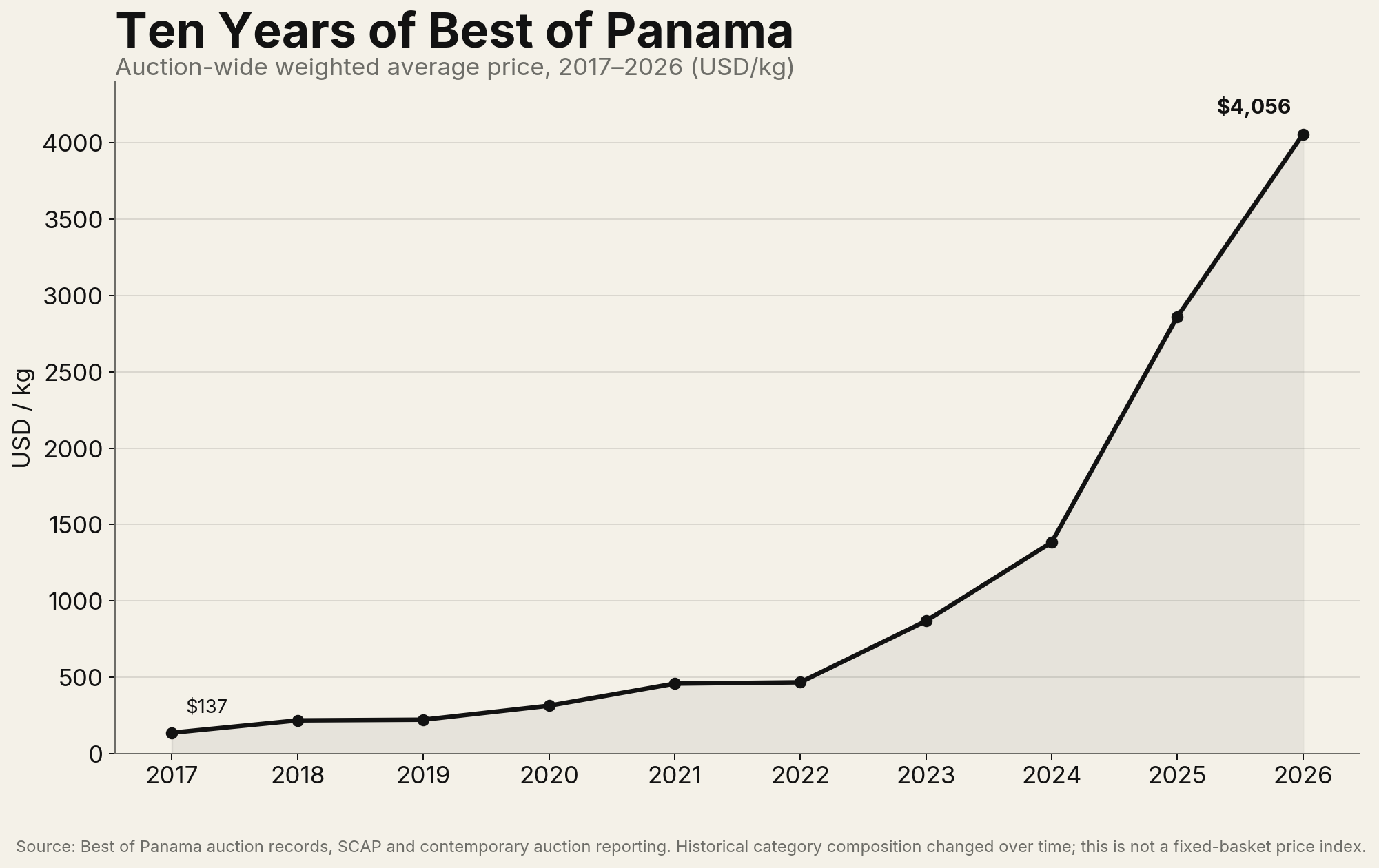
In 2017, 51 Best of Panama lots sold at an auction-wide average of US$61.98/lb, or roughly US$137/kg.
The average moved to US$98.68/lb in 2018 and just above US$100/lb in 2019. By 2024, the weighted average had reached US$627.27/lb, approximately US$1,383/kg.[4]
Then came US$2,861/kg in 2025 and US$4,056/kg this year.[1][2]
I would be careful with a direct ten-year comparison.
The auction itself changed during this period.
Older Best of Panama editions separated Geisha, Pacamara and Traditional categories in ways that are different from the current Geisha Washed, Geisha Natural and Varietal structure. Lot size and the number of coffees offered have also changed.[8]
So I do not think this should be treated as a fixed-basket price index.
Still, the direction is difficult to ignore.
This is not simply a history of one record-breaking coffee replacing another.
The price level across the top end of Panama coffee has changed.
A lower peak, but much less concentration
There is another comparison that I think explains 2026 particularly well.
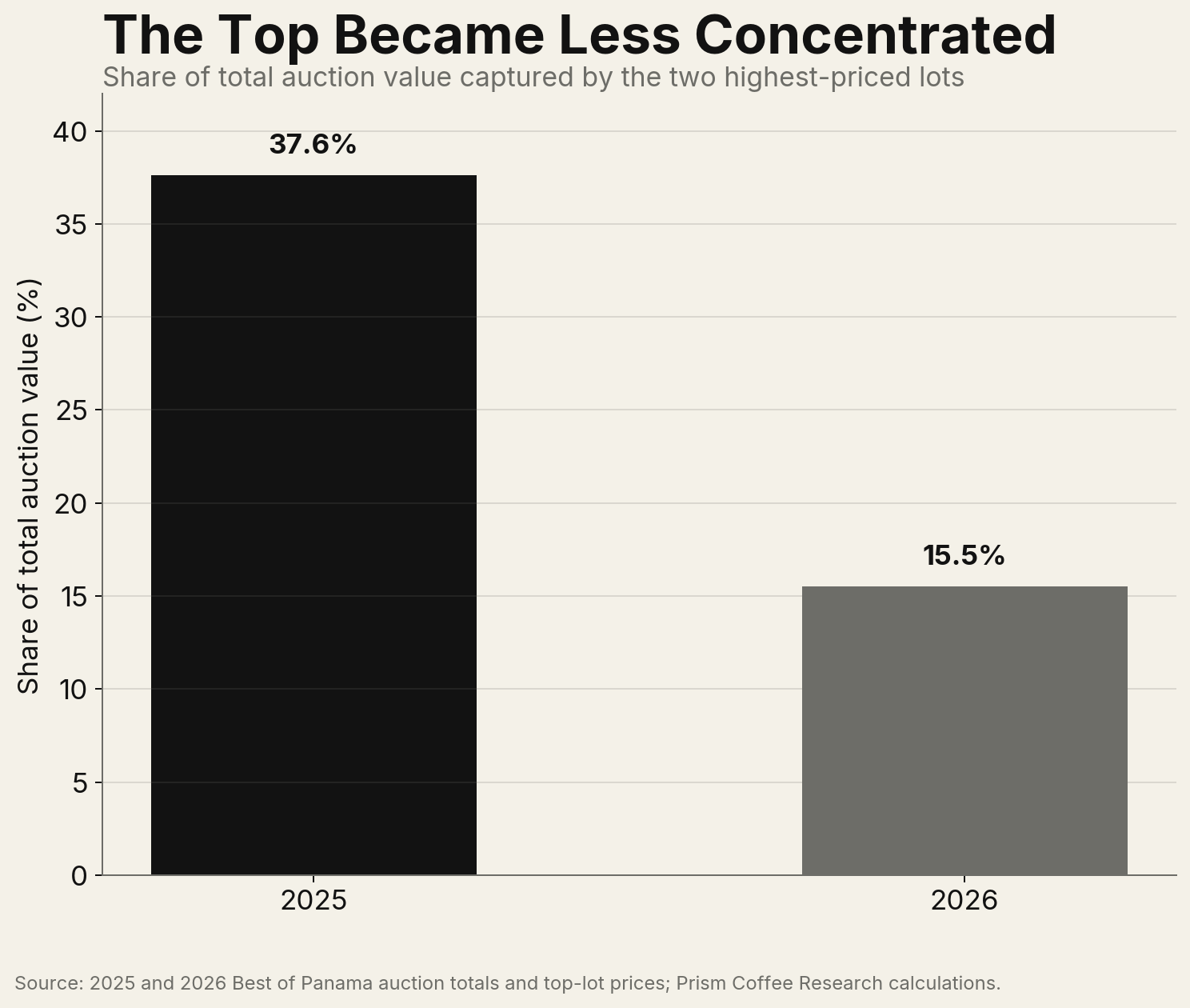
In 2025, the two most expensive lots — both from Hacienda La Esmeralda — represented roughly 38% of total auction revenue.
In 2026, the top two lots represented about 16%.[3]
That is a large difference.
Last year, an unusually large part of the auction value sat at the very top.
This year the money was spread much more broadly through the table.
This is why I think of 2025 as a more record-driven market, while 2026 looked more depth-driven.
That does not make the record irrelevant.
A US$30,000/kg coffee creates attention far beyond the people who actually buy it. It gives the origin a reference point and changes the conversation around price.
But from a market perspective, I find it more interesting when high prices stop belonging to one or two coffees.
Why did it take 19 hours and 30 minutes?
The duration of this year’s auction was unusual.
The 2025 auction recorded 18,988 bids.
This year there were 24,544.[1][2]
At the same time, the auction continued for approximately 19 hours and 30 minutes.
It is tempting to describe that simply as strong demand.
I think that explanation is too easy.
If we divide total bids by auction duration, the hourly pace was actually slower than in 2025.
So the auction was both busier and slower.
There are several plausible reasons.
Lot size fell from 20kg to 15kg.
Competition was spread across more coffees.
Buyers were participating from a wide range of time zones.
And 83 bidders from 21 countries took part, with the final lots going to 29 buyers across 11 countries.[5]
What we can say with some confidence is that the long auction was not caused by a lack of activity.
What we cannot say — at least from the final results alone — is exactly which bidding mechanism caused those 19.5 hours.
For that, we would need the complete bid-by-bid timestamps.
I would rather leave that uncertainty visible than turn it into a cleaner story than the data supports.
Asia did not suddenly discover Panama in 2026
Another easy headline would be to call this the year Asian buyers took over Best of Panama.
The history does not really support that.
In 2017, 37 of the 51 auction lots already went to buyers in Taiwan, China, Hong Kong, Japan, Thailand, Indonesia and South Korea.[4]
Asian demand has been part of this market for a long time.
What stands out in 2026 is the concentration of auction value.
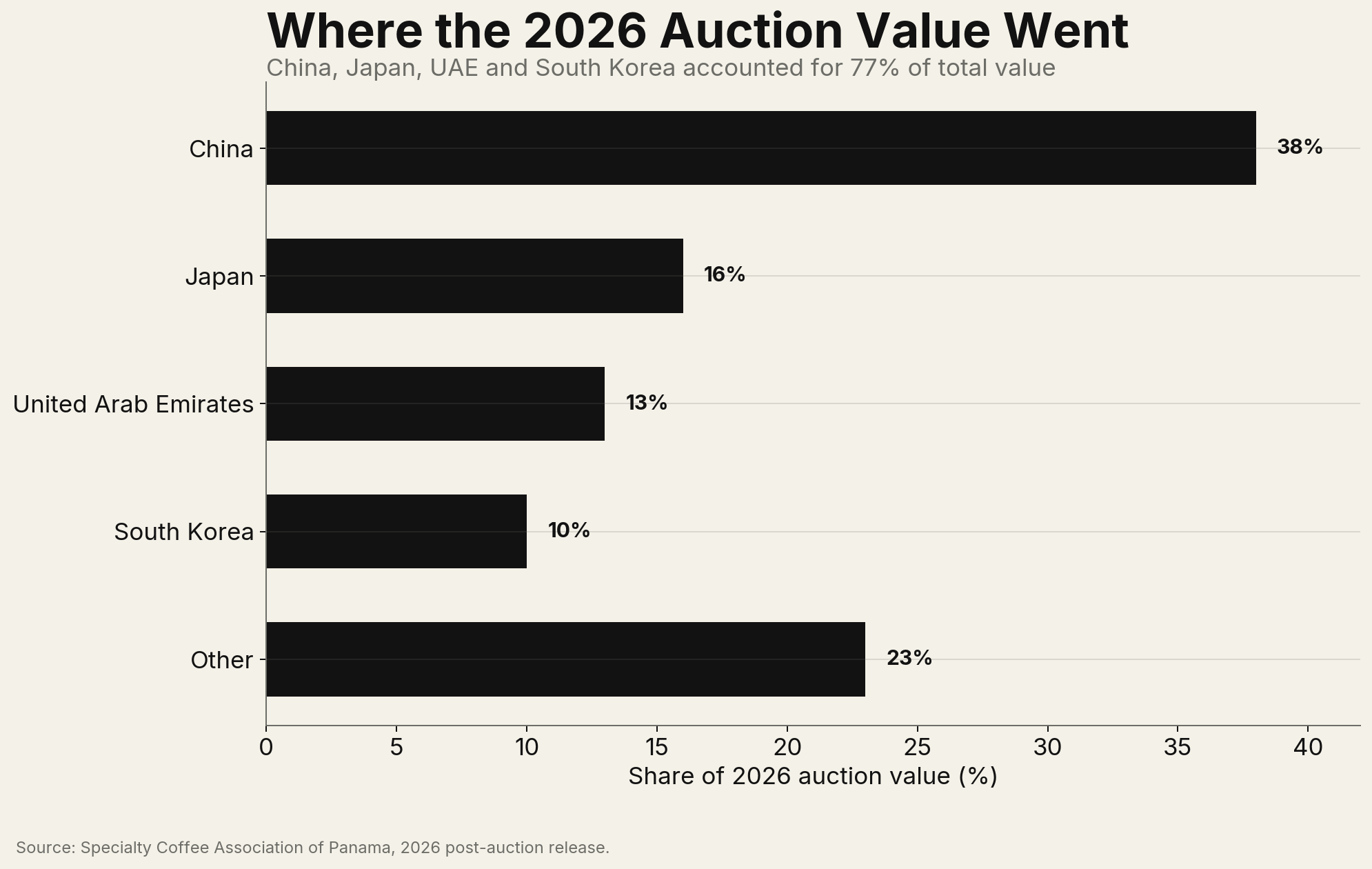
China represented 38% of total value.
Japan accounted for 16%, the UAE 13%, and South Korea 10%.[5]
Those four markets together represented 77% of the auction value.
So I would describe the change differently.
East Asian demand is not new.
China has become particularly important at the highest price levels, while the Gulf — especially the UAE — is now large enough that it should be considered part of the core market rather than a peripheral buyer.
Why buyer utility matters
A 15kg lot purchased for US$10,000/kg is not necessarily being bought under the same logic as a normal green coffee contract.
That distinction is important.
The coffee may be used for an invitation-only tasting.
It may become a competition coffee.
It may be divided between several markets.
It may be used as a flagship release, a media story or a way to bring customers into a brand.
Sometimes the value of the purchase is not entirely in the margin of the coffee itself.
That is what I mean by buyer utility.
The same 15kg can have a very different economic meaning to a buyer in Shanghai, Tokyo, Seoul or Dubai.
This also makes auction price harder to explain with cup score alone.
Geisha Washed: score matters, but it does not finish the conversation
The 2026 Geisha Washed results were very strong.
Elida Estate finished first at 96.25 points.
Finca El Pergamino followed at 96.00, and Hacienda La Esmeralda finished third at 95.25.[6]
At auction, Elida Geisha Torre reached US$18,004/kg.
What is more interesting is the next pair.
Hacienda La Esmeralda reached US$10,014/kg, while the higher-scoring El Pergamino sold at approximately US$9,936/kg.[3][5]
The price difference is small.
I would not use two coffees this close together to claim that we have proven a measurable Esmeralda brand premium.
But it does show where score stops being a complete explanation.
At this level, every coffee has already passed through a very demanding quality filter.
Buyers are not choosing between a good coffee and a bad one.
They are choosing between exceptional coffees.
That leaves more room for other things to matter: the estate, the history of the lot, scarcity, previous experience with the producer, and how easily that coffee can be communicated to customers.
The sensory language is also worth watching
The official judging language from this year is interesting in its own right.
Washed Geishas were repeatedly described through characteristics such as jasmine, peach, bergamot, stone fruit and citrus.
More interesting to me was the repeated emphasis on clean expression, varietal character and coffees showing little obvious evidence of processing.[7]
Processing has been one of the loudest subjects in specialty coffee for quite a few years.
That makes the language at the top of this table worth paying attention to.
The ideal being described is not necessarily the coffee with the most obvious process.
It is a coffee where process allows the variety and place to remain readable.
I am not ready to call this a market-wide reversal.
But it is a direction I would like to keep watching.
Geisha Natural: why Lérida is useful to look at
The Natural category was also very close.
Lérida Waterfall finished first with 95.63 points.
Hacienda La Esmeralda followed at 95.50, and Elida Estate at 95.25.[6]
At auction, Lérida Waterfall reached US$13,505/kg, making it the second-highest-priced coffee of the entire auction.[5]
I have a personal connection with Lérida, so I am also conscious of not making too much of one result.
What makes it useful here is not simply that Lérida won.
It is an old, established estate.
This was not a producer that appeared around a single competition coffee or an unusually novel process.
In this case, the competition result and the market result lined up.
That makes Lérida a useful example of what can happen when cup quality and an established producer identity reinforce each other.
It does not prove that the farm name caused the price.
But it gives us a good question to test against the longer dataset.
Do farms such as Esmeralda, Lamastus, Lérida, Janson, Hartmann or Sophia consistently sell above coffees with similar scores in the same category?
If they do, that is where the idea of farm identity becomes something we can measure rather than simply talk about.
Natural does not simply mean more process
There is another part of the Natural results that I find interesting.
The sensory descriptions included floral character, raspberry, strawberry and red fruit, but the judges also repeatedly talked about definition and cleanliness.
Janet Janson described a tendency toward more classic natural expressions.[7]
For me, the interesting question is no longer whether a Natural can produce more flavor intensity.
We know it can.
The better question is:
Can the process increase expression without becoming the first thing we taste?
That becomes especially relevant at this level of the market.
And it is one of the reasons I do not want to fill this first edition with tasting notes taken from other Lérida, Elida or Esmeralda coffees and present them as if they were descriptions of these auction lots.
They are not the same coffees.
Once the 2026 lots arrive at roasters and actual post-roast reviews begin to appear, this section should be updated.
Varietals may be becoming their own premium category
The Varietal category may end up being one of the most important parts of this market over the next few years.
In 2026, Altieri won with 93.63 points, followed by Hacienda La Esmeralda at 92.63 and Finca Santa Teresa at 92.38.[6]
The ten Varietal lots averaged approximately US$1,945/kg.
The 40 Geisha lots averaged approximately US$4,584/kg.[3]
That is still a very large difference.
For that reason, I do not think we are looking at a market moving beyond Geisha.
Geisha remains the main reference.
But US$1,945/kg is hardly an ordinary secondary category.
It suggests something else may be forming underneath Geisha: a separate high-value market for non-Geisha Panama coffees.
I think the distinction is important.
If every Varietal is valued according to how closely it resembles Geisha, it will always live in Geisha’s shadow.
The more interesting possibility is that Laurina, Pacamara, SL selections, Typica and other coffees become valuable because they offer a different sensory experience.
Panama is also protecting that distinction
SCAP has become increasingly strict about what qualifies for the Varietal category.
In 2026, non-Geisha Varietal entries were genetically checked to verify that they did not contain Geisha material.[7]
That may sound like a technical detail, but I think it says something important about where the category is going.
The interesting question is no longer:
Can another variety taste like Geisha?
It is:
Can Panama build another valuable sensory identity without borrowing Geisha’s genetics or reputation?
If the answer becomes yes, the market does not simply replace one variety with another.
It becomes wider.
What is the market actually paying for?
Looking at the 2026 results, I keep returning to five things:
Cup quality
Farm identity
Scarcity
Provenance
Buyer utility
I would not turn that into a pricing equation.
We do not yet have enough data to assign a clean weight to each factor.
But cup score alone clearly leaves part of the price unexplained.
Farm identity matters because customers may already know a producer before they taste the coffee.
Scarcity matters because these are 15kg releases rather than repeatable commercial contracts.
Provenance matters because a farm, plot, harvest, variety and competition history can all be traced.
Buyer utility matters because the coffee may be worth more to one buyer than another depending on what they can do with it.
None of this replaces quality.
It sits on top of it.
One thing I would not overstate: global demand
The auction included bidders from 21 countries.
That is clearly international.
But this is still a very small market.
The entire 2026 auction moved 750kg of green coffee.[2]
That number matters.
US$4,055.92/kg is not the wholesale market price of Panama Geisha.
It is the weighted average of 750kg selected through one of the most competitive specialty coffee programs in the world.
These lots can influence expectations, reputation and pricing far beyond their physical volume.
But the auction should not be confused with the broader Panama green coffee market.
Keeping those two markets separate makes the BOP numbers more useful.
What happens to Best of Panama from here?
Best of Panama is no longer the only place where a well-known Panama estate can discover the value of its best coffee.
Leading producers increasingly have direct allocations, long-term buyers and private auctions of their own.
I do not think that necessarily makes BOP less important.
It may change its job.
I increasingly see three different roles developing.
Best of Panama as a benchmark
An independent competition that gives the market a common quality reference.
Estate releases and private auctions as producer markets
Places where an established farm can translate its own reputation directly into price.
Direct allocation as the scalable business
The part of the relationship where volume, continuity and repeat purchasing happen.
That structure also changes how I think about trophy lots from a buyer’s side.
A 15kg BOP lot does not necessarily have to carry the economics of the entire relationship.
It can create attention.
Another 100 or 300kg from the same estate can create the actual business.
That makes more sense to me than expecting every US$10,000/kg coffee to work like a conventional retail product.
What I will watch in 2027
I do not think the most useful question next year will be whether someone breaks US$30,204/kg.
That would make a good headline.
It would not necessarily tell us much about the market underneath it.
I will be more interested in:
- median auction price
- 25th and 75th percentile
- Geisha price floor
- Varietal price floor
- top-five revenue concentration
- repeat buyers
- buyer-country concentration
- score-to-price relationship
- whether the same estates continue to outperform similarly scored coffees
- and, finally, what buyers say once these coffees are actually roasted and served
There are several possible outcomes.
The 2026 floor may hold.
More supply may bring part of the market back down.
Or the overall market may stay strong while the gap between established producer names and the rest becomes wider.
We do not know yet.
That is one of the reasons I think following the data beyond a single auction is more useful than trying to predict the next record.
Where does the price of a good coffee come from?
The 2026 Best of Panama did not break the highest-price record.
I think it showed something more useful.
A price range that used to belong to a relatively small number of coffees is now being occupied by many more lots and producers.
That does not mean cup quality became less important.
It means quality is increasingly being read together with the producer, the place, the history, scarcity and the way a buyer can use the coffee after purchase.
So when we talk about the value of Geisha from here, I think we need to look beyond champion lots and world records.
The average matters.
The median matters.
The producer’s history matters.
And eventually, the cup still has to explain why the rest of it was worth paying for.
That is probably the part I am most interested in following next.
Methodology & Data Limitations
This first edition uses Best of Panama auction records from 2017 through 2026, SCAP competition and auction releases, published lot-level auction data and contemporary industry reporting.
Historical auction categories are not identical.
Earlier editions used category structures including Geisha, Pacamara and Traditional coffees, while recent editions are structured around Geisha Washed, Geisha Natural and Varietals. Lot size and auction composition have also changed over time.[8]
For that reason, long-term auction averages in this report should be read as market-level indicators rather than a like-for-like coffee price index.
The 2025–2026 median, category averages and concentration calculations are based on published lot-level auction results.
This edition does not yet treat buyer or consumer tasting notes as representative sensory data for the 2026 auction coffees. Those coffees have only recently been sold, and post-roast feedback is still limited.
A later update will add:
- buyer and roaster release data
- social-media monitoring
- post-roast sensory descriptions
- retail pricing
- structured sensory coding
- score-price correlation
- farm-level price residuals
- repeat-buyer analysis
First published: September 2026
Youngjun Cho
Notes & Sources
[1] Best of Panama Auction 2025 — “Canvas of Terroir.”
Primary auction record used for the 2025 lot size, 18,988 bids, US$2,861,200 total value, US$2,861.20/kg weighted average and US$30,204/kg highest price.
[2] Best of Panama Auction 2026 — “Timeless Resonance.”
Primary auction record used for the 2026 lot-level results, 24,544 bids, US$3,041,940 total value, US$4,055.92/kg weighted average, US$18,004/kg highest price and 15kg lot size.
[3] Nexo — Best of Panama 2026 auction analysis.
Used for lot-level distribution calculations: US$2,835/kg median in 2026 vs US$1,093/kg in 2025, 48 of 50 lots above US$1,000/kg, category averages, and top-two revenue concentration of approximately 38% in 2025 vs 16% in 2026. nexo.la
[4] Daily Coffee News — historical Best of Panama auction reporting.
Used for historical market context, including the 2017 average of US$61.98/lb and Asian buyer participation, the 2018 average of US$98.68/lb, the 2019 auction average above US$100/lb, and the 2024 weighted average of US$627.27/lb. Daily Coffee News by Roast Magazine
[5] Specialty Coffee Association of Panama — 2026 post-auction release.
Used for 2026 buyer participation, buyer-country value shares, Lérida’s US$13,505/kg result, and the US$10,014/kg and US$10,024/kg prices for Hacienda La Esmeralda’s Washed and Natural Geishas. Scap Panama
[6] Specialty Coffee Association of Panama — 2026 competition results.
Used for final competition scores and rankings: Elida Estate 96.25 in Geisha Washed, Lérida 95.63 in Geisha Natural, and Altieri 93.63 in Varietals, along with the remaining podium positions. Scap Panama
[7] Specialty Coffee Association of Panama — 2026 national cupping reports.
Used for sensory observations including jasmine, peach, bergamot, stone fruit, citrus, clean processing expression and the reported move toward more classic Natural profiles. Also used for SCAP’s controls around varietal identity. Scap Panama
[8] Best of Panama historical auction records, 2017–2021.
Primary records used to verify changes in category structure and auction presentation over time.
*This is a living report. Buyer releases, post-roast sensory feedback and additional auction analysis will be added as reliable data becomes available.